The Fantasy-Architects’ Guide to the Gaps of the City

How can performance enable people to perceive and collectively reimagine overlooked urban spaces?

Dongsoong-dong, Seoul · 2025
WalkingMappingParticipationSpatial Dramaturgy
Watch full video
Poster for The Fantasy-Architects’ Guide to the Gaps of the City

Project Overview

The Fantasy-Architects’ Guide to the Gaps of the City was a site-specific performance and research project staged within a single block of Dongsoong-dong, Seoul. It explored how performance could help people notice overlooked urban spaces and collectively reimagine their possibilities.

The project unfolded through three walks along the same route. Non-verbal movement, FM radio, textual prompts and participatory mapping shaped each journey. Audiences moved from observation to participation and finally to independent exploration. The performance gradually shifted their role from following someone else’s reading of the city to forming their own.

Methods

Repeated walking
The same route was experienced three times, with a different form of engagement in each round.
Embodied performance
Movement and bodily gestures were used to direct attention to gaps along the route.
Shared sound
Portable FM radios carried live electronic music as audiences moved through the site.
Textual prompts
Manifesto cards introduced ideas and prompts at different points along the route.
Participatory mapping
Participants recorded the gaps they discovered on transparent maps, which were later overlaid to compare different readings of the site.

01. Reading the Gaps

What is a gap?

In this project, a gap refers to an interstitial part of the city whose use or meaning remains unsettled. It may appear between buildings, at the edge of a property, along a threshold, or in a place that changes according to time and use.

A gap was understood as a space that could support more than one interpretation. Different people could notice different qualities in the same place and imagine different ways of inhabiting it.

Locations of gaps identified along the Dongsoong-dong route

Reading the site

The performance took place within a single block of Dongsoong-dong. Residential streets, shops, vacant spaces, building edges and changes in level created different spatial conditions along the route.

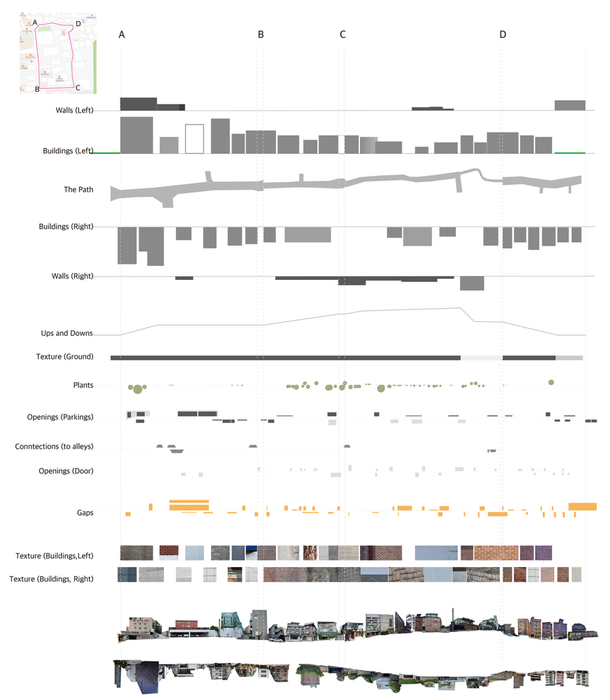
The site was studied by walking through the block and recording how these conditions changed along the way. Openings, walls, slopes, stairs and overlooked spaces were mapped as a spatial sequence. This notation helped identify potential gaps and trace how they appeared and disappeared through movement.

Site analysis of the Dongsoong-dong block showing route, buildings, walls, levels, textures, openings and gaps

02. Designing the Performance

The performance was structured around three walks through the same block.

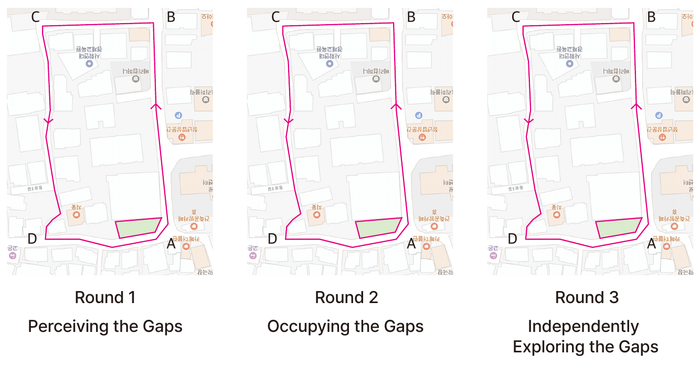
Each round offered a different way of encountering the same route. In the first, audiences followed the performers and observed the gaps they encountered. In the second, they entered and occupied these spaces with the performers. In the final round, they explored the route independently and identified gaps for themselves.

Across the three rounds, the audience took a more active role in reading and experiencing the site.

Three diagrams showing the route for Round 1, Round 2 and Round 3

Round 01: Perceiving the Gaps

In the first round, audiences followed the performers through the site.

Through gaze, movement and pauses, the performers drew attention to gaps along the route. Audiences followed their actions and noticed spaces they might otherwise have passed by.

Round 02: Occupying the Gaps

In the second round, audiences entered the gaps with the performers.

They were invited to sit, lean, hide, cross, pause and play within the spaces encountered during the first round. These actions offered different ways of using and experiencing each gap.

Round 03: Exploring the Gaps

In the final round, audiences explored the route independently.

Each participant received a DIY kit containing a map, transparent OHP film and drawing tools. They chose where to stop, identified their own gaps and recorded what they discovered on the map.

Each participant produced their own reading of the block through this final walk.

Round 03 DIY kit with map, transparent film and drawing tools

03. Becoming a Fantasy-Architect

The project used the term fantasy-architect to describe someone who discovers possibilities within existing spaces through observation, imagination and action.

Across the three rounds, audiences moved from following the performers’ reading of the site to making their own. By the final round, each participant chose what to notice, where to stop and what to recognise as a gap.

Becoming a fantasy-architect meant finding one’s own way of reading and imagining the city.

From individual readings to a shared map

At the end of the final walk, participants returned to the playground and overlaid their transparent maps.

The resulting map brought their individual readings of the block together. Some gaps appeared across several maps, while others were identified by only one participant. Layering the maps made it possible to see where these readings met and where they differed.

Gaps Discovered by Audiences

First Performance (4, Sept. 2025)
Combined audience map from the first performance on 4 September 2025
Individual audience map 1 from the first performanceIndividual audience map 2 from the first performanceIndividual audience map 3 from the first performanceIndividual audience map 4 from the first performanceIndividual audience map 5 from the first performanceIndividual audience map 6 from the first performance
Second Performance (5, Sept. 2025)
Combined audience map from the second performance on 5 September 2025
Individual audience map 1 from the second performanceIndividual audience map 2 from the second performanceIndividual audience map 3 from the second performanceIndividual audience map 4 from the second performanceIndividual audience map 5 from the second performanceIndividual audience map 6 from the second performance
Third Performance (6, Sept. 2025)
Combined audience map from the third performance on 6 September 2025
Individual audience map 1 from the third performanceIndividual audience map 2 from the third performanceIndividual audience map 3 from the third performanceIndividual audience map 4 from the third performanceIndividual audience map 5 from the third performance
Fourth Performance (7, Sept. 2025)
Combined audience map from the fourth performance on 7 September 2025
Individual audience map 1 from the fourth performanceIndividual audience map 2 from the fourth performanceIndividual audience map 3 from the fourth performanceIndividual audience map 4 from the fourth performanceIndividual audience map 5 from the fourth performanceIndividual audience map 6 from the fourth performance

04. Reflections

The same place could be seen differently

Returning to the same route changed what audiences noticed. Spaces passed by in the first walk could take on new significance when encountered again through different actions and perspectives.

Small actions could change how a space was experienced

Sitting at an edge, crossing a boundary or spending time in an overlooked space opened up uses that were not immediately apparent. The physical setting remained the same, but the way it was occupied could change.

Each person found different gaps

The audience maps showed how differently the same block could be read. Some gaps appeared repeatedly, while others were unique to individual maps. When layered together, the maps made these shared and individual readings visible.

Manifesto of Gaps

  1. A gap is a hospitable space.
  2. A gap can be discovered here and now.
  3. A gap can be a place to imagine somewhere else.
  4. A gap guarantees the freedom to have some quality time alone.
  5. The fun that arises in a gap can expand beyond it.
  6. A gap allows for the making of small communities.
  7. The same gap may be understood as a different place depending on who perceives it.
  8. A gap may be difficult to occupy. There are those who do not welcome its freedom to remain a gap.
  9. A gap leaves traces, but not necessarily the physical ones.
  10. A gap cannot be owned. It can only be sensed.

Project information

Year
2025
Location
Dongsoong-dong, Seoul, Korea
Format
Site-specific urban performance-research
Research
2024–2025
Performance
4–7 September 2025
Director
Sehee Hwang
Performers
Eunjae Jung, Heebeom Choi, Sunhee Nam
Producer
Hoyeon Lee
Composer
Sebin Shin
Costume designer
Hojin Jeong
Sponsored by
Seoul Foundation for Arts & Culture; Seoul Street Arts Creation Center