The Touch of the Untouched was a 1:1 site-specific telephone performance staged in Huam-dong, Seoul. The project explored how narrative and space could shape one another through each audience member’s chosen path.
A mysterious voice invited the audience to walk toward Namsan Tower while listening to a story over the phone. Participants were free to choose their own routes, which allowed the same narrative to unfold through different encounters with the city.
Methods
Walking
Audience movement activated the relationship between narrative and Huam-dong’s spatial conditions.
Narrative Cues
The narrator suggested direction and destination without prescribing a route.
Spatial Dramaturgy
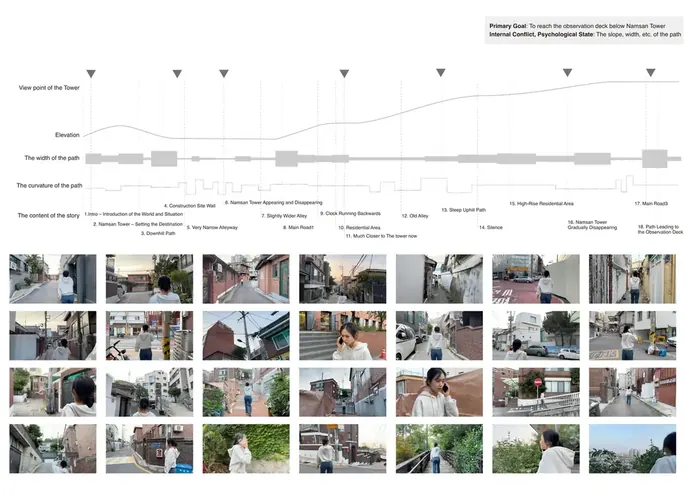
Narrative progression was developed in relation to landmarks, slopes, alleys and spatial sequences.
GPS Tracking
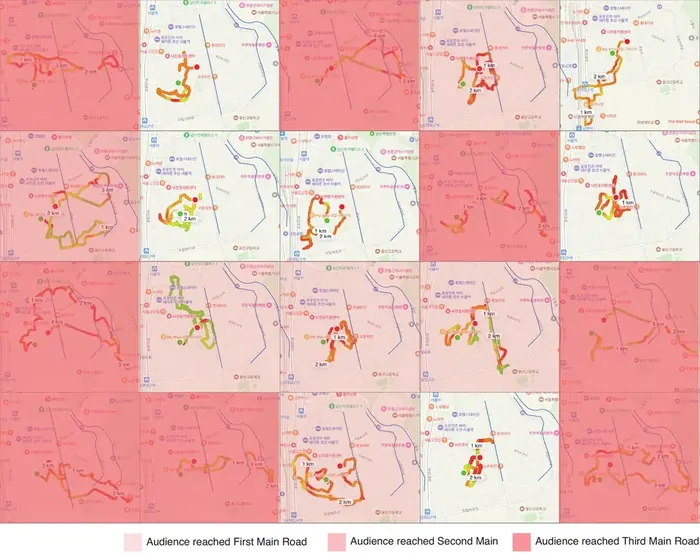
Audience trajectories were recorded and compared with the expected movement.
Post-Performance Survey
Audience reflections helped examine differences in how story and space resonated across journeys.
01
Conceptual framework
Framing Spatial Dramaturgy
01
Psychogeography
Psychogeography provided a way to understand Huam-dong as an affective landscape. The audience moved through the neighbourhood without a predetermined route, while the story suggested a possible direction toward Namsan Tower.
Each journey developed through the encounter between narrative cues and the changing conditions of the city. Detours, unfamiliar streets and moments of disorientation could alter how the story was experienced.
02
Space, Event and Movement
Bernard Tschumi’s relationship between space, event and movement offered another framework for the project.
The script was developed in relation to actual spatial sequences in Huam-dong. Alleys, slopes, changes in width and views toward Namsan Tower became part of the dramaturgy. These spatial conditions shaped the unfolding experience as the audience moved through them.
03
Toward Spatial Dramaturgy
The project brought these ideas together through spatial dramaturgy.
The story provided direction and narrative tension. The city introduced uncertainty and variation. The audience’s path became the point where these two systems met.
Spatial dramaturgy emerged through this relationship between narrative, movement and the changing conditions of the city. The same story could therefore unfold differently according to the route each participant took and the situations they encountered along the way.
02
Performance design
Designing the Journey
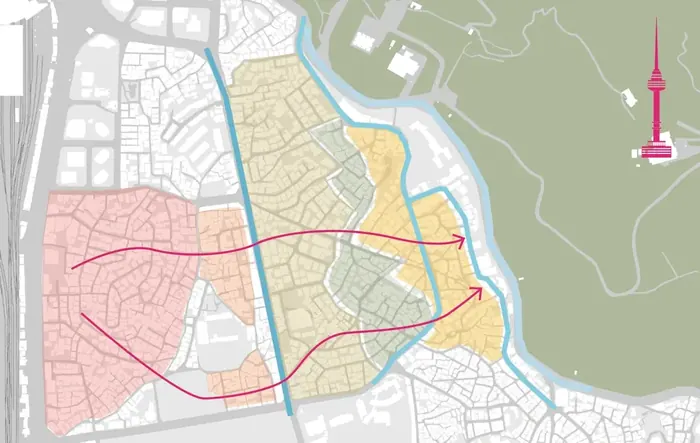
Huam-dong and Namsan Tower
Huam-dong is a hillside neighbourhood shaped by slopes, narrow residential streets and frequent changes in elevation.
Namsan Tower repeatedly appears and disappears between buildings and streets, making it a visible landmark across the neighbourhood.
The Performance Format
01
Telephone Encounter
The performance began with a phone call. A woman’s voice shared fragments of a story and suggested a meeting near Namsan Tower.
The performer and the audience moved separately through the city. Their connection existed through the telephone and through the possibility that their journeys might eventually meet.
02
Free Movement
The audience was not given a fixed route.
Each participant could decide where to walk and whether to follow the direction suggested by the story. The same narrative therefore unfolded through different spatial sequences.
03
Rule of Silence
The audience could not speak during the call. If they responded, the call would end.
This rule shifted the audience’s response from speech to movement. Their decisions became visible through where they walked, where they stopped and whether they continued toward the landmark.
Aligning Story and Space
The performance was structured around a journey toward Namsan Tower. Although each audience member could choose their own route, the landmark provided a shared direction through Huam-dong.
The neighbourhood’s hillside terrain created recurring spatial conditions along this direction. Narrow alleys, slopes, changes in path width and shifting views of Namsan Tower were mapped alongside the progression of the story. Particular narrative moments were then developed in relation to these spatial situations.
The performer and audience moved separately through Huam-dong. At some moments, the narrative aligned closely with the audience’s surroundings. At others, their chosen path created unexpected relationships between story and space. Each journey therefore produced its own spatial dramaturgy.
03
Audience experiment
Testing the Journey
The performance was staged twenty times for twenty individual audience members. Each participant experienced the journey alone while connected to the performer by phone.
GPS tracking recorded all twenty routes and allowed the actual journeys to be compared with the intended direction toward Namsan Tower.
14 / 20reached the first main road
10 / 20crossed the first main road
9 / 20reached the second main road
8 / 20crossed the second main road
The results showed that the narrative could guide movement, but it did not determine a single route. Some participants followed the intended direction closely, while others diverged at different points.
Participants who moved toward Namsan Tower often reported moments when the story appeared to correspond closely with their surroundings.
The narrator’s emotional tone gave them a reason to continue. References to the Tower created a sense of direction. Changes in the landscape also reinforced the anticipation of eventually meeting the narrator.
For these participants, movement through the city became closely connected to the progression of the story.
Diverging from the landmark
Other participants chose different routes or became lost within Huam-dong.
These journeys produced less consistent alignment with the intended spatial structure, but they still generated moments of resonance. Unexpected streets, detours and chance encounters created new relationships between the narrative and the city.
The story therefore remained active even when the audience moved outside the predicted route.
04
Findings
Project Reflections
01
Narrative can guide movement without determining it
The story influenced the direction of many audience journeys, but participants still made their own spatial decisions. The performance created a structure that could guide movement while leaving space for divergence.
02
Space reshapes the experience of narrative
The same story developed differently according to each participant’s surroundings. Streets, slopes, detours and moments of disorientation changed how the narrative was interpreted and experienced.
03
Divergence can create its own resonance
Moving away from the intended route did not end the relationship between story and space. Participants who diverged formed their own connections through unexpected encounters with the urban environment.
Project information
Year
2023
Location
Huam-dong, Seoul, Korea
Format
1:1 site-specific telephone performance
Performance
24–27 August 2023
Director
Sehee Hwang
Dramaturg
Hangyeol Park
Producer
Hoyeon Lee
Performers
Soyul Moon, Yurim Moon, Yeri Sim, Chaeyeon Jang, Seung-dong Yang
Supported by
Seoul Foundation for Arts & Culture Seoul Street Arts Creation Center